
AI Can Now Control Your Computer
Perplexity Computer

If you’ve been using AI regularly, you’ve probably noticed something interesting.
AI has become incredibly smart. It can write documents, summarize research, generate visuals, and even help you build software. But despite all this intelligence, there has always been one major limitation.
AI tells you what to do.
You still have to do the work.
You open the tabs.
You download the files.
You move data between tools.
You complete the workflow.
Using AI today often feels like working with a brilliant intern who never touches the keyboard.
It gives perfect instructions, but you still execute everything yourself.
Perplexity is now trying to change that.
The company has introduced something called Perplexity Computer, a system designed to move AI beyond answering questions and into executing entire workflows.
Perplexity describes it as a general-purpose digital worker that operates the same software interfaces humans do. Instead of simply generating responses, the system can coordinate multiple AI models, create agents, and deliver finished outputs.
In this edition, we’ll break down:
What Perplexity Computer actually is
How you can access it
How it works behind the scenes
The AI models powering it
Real examples of what it can do
Why this represents a shift in how AI systems operate
What is Perplexity Computer?
First, an important clarification.
Perplexity Computer is not hardware.
Perplexity hasn’t launched a new physical device.
Instead, it’s a new AI system designed to function like a digital worker.
Traditional AI tools generally fall into two categories:
Chatbots
Answer questions
Generate text
Provide research assistance
Agents
Perform individual tasks
Perplexity Computer is designed to go further than both.
It’s what Perplexity calls a multi-modal AI workflow system that can create and execute entire workflows from start to finish.
Rather than completing a single task, the system can coordinate multiple steps across different tools and models.
Another notable capability is that these workflows can run for hours, days, or even months, depending on how complex the task is.
How to Access Perplexity Computer
Perplexity Computer is already available, but access is currently limited.
Right now it is accessible to:
Perplexity Max subscribers
The company has also announced that the feature will soon expand to:
Enterprise Max users
At the moment, the system is positioned as a premium capability aimed at professionals and teams that rely heavily on AI-driven workflows.
How Perplexity Computer Works
Perplexity Computer operates software the same way a human coworker would — by using it.
The system can:
reason about tasks
delegate work
search the web
build documents
write code
remember information
deliver finished outputs
Instead of asking questions, users start by describing an outcome.
For example:
prepare a product launch kit
generate research documents
extract a video clip
Once the outcome is defined, the system begins executing the workflow.
Here’s what happens behind the scenes:
The AI interprets the goal.
The task is broken into subtasks.
Sub-agents are created to handle each part.
The agents execute tasks simultaneously.
These agents might perform activities such as:
web research
document generation
data processing
API calls to connected services
For example, one agent might gather data while another drafts a document using that information.
All of this work is coordinated automatically and asynchronously, meaning the workflow can continue running in the background while you focus on other work.
If the system encounters a problem, it can create additional agents to solve it, research missing information, or even generate code if necessary.
Each task runs in an isolated compute environment with access to:
a real filesystem
a real browser
tool integrations
This allows the system to interact with software environments much like a human user would.
Users can even run multiple Perplexity Computers in parallel, allowing several workflows to run simultaneously.
The AI Models Behind Perplexity Computer
One of the most interesting aspects of the system is that it doesn’t rely on a single AI model.
Perplexity designed the platform to be model-agnostic, meaning it can orchestrate multiple models depending on the task.
Different models specialize in different types of work.
As of now, Perplexity Computer uses:
Opus 4.6
Core reasoning engine responsible for overall decision-making.
Gemini
Used for deep research and creating sub-agents.
Nano Banana
Handles image generation and visual tasks.
Veo 3.1
Used for video creation and processing.
Grok 4
Handles fast execution of lightweight tasks.
ChatGPT 5.2
Supports long-context recall and broad search.
Because the system coordinates multiple models, it can use the best tool for each specific part of a workflow.
Example: Turning a Podcast Into a Social Media Clip
One demonstration shared by Perplexity shows how the system can automate a content creation workflow.
Imagine you want to create a short TikTok clip from a long podcast episode.
Normally, this process requires several steps:
opening the video
downloading the file
finding the correct segment
trimming the clip
converting it to vertical format
adding captions
exporting the video
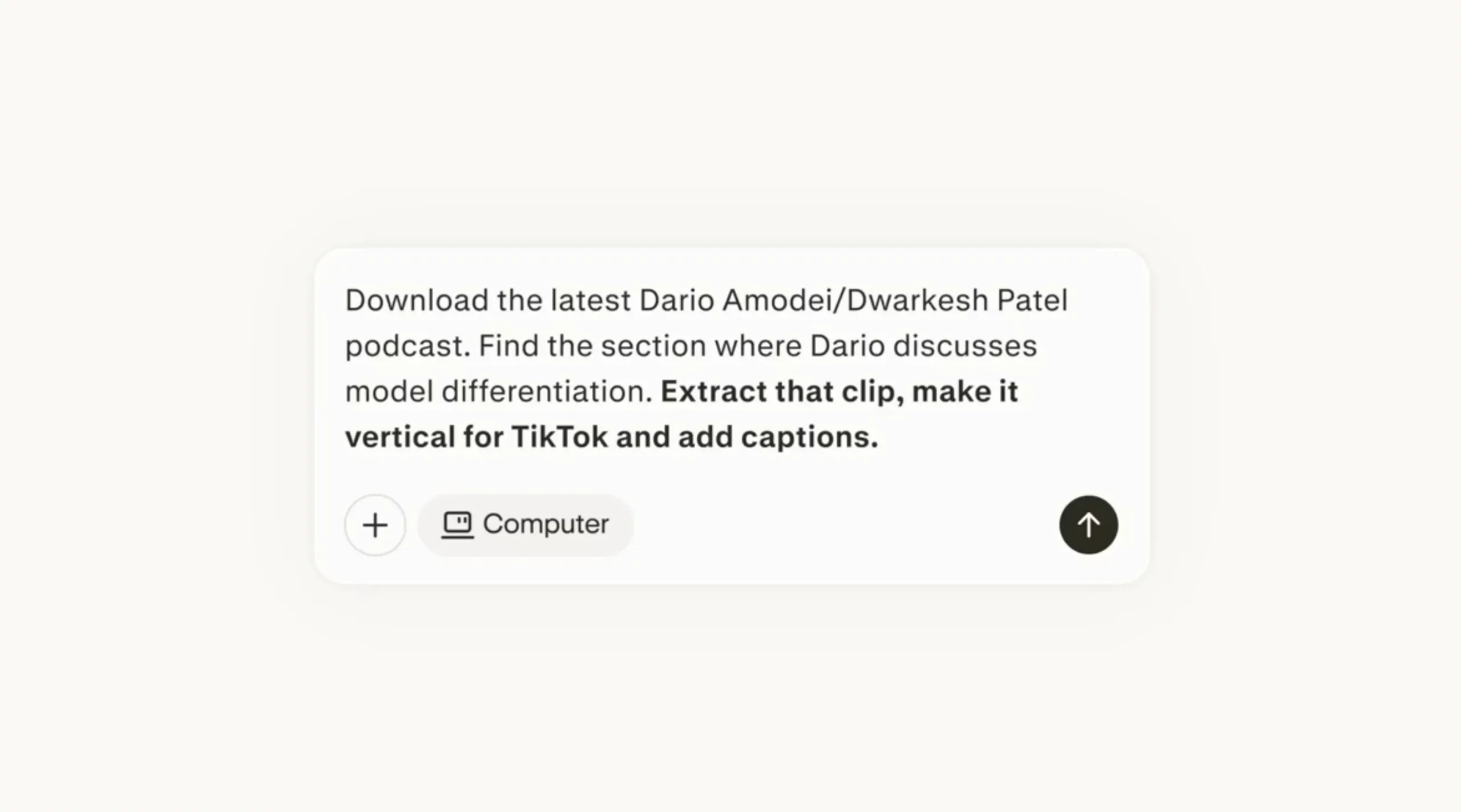
With Perplexity Computer, you could simply provide a prompt like this:
“Download the latest Dario Amodei & Dwarkesh Patel podcast. Find the segment where they discuss model differentiation. Extract the clip, convert it into vertical format, and add captions for TikTok.”
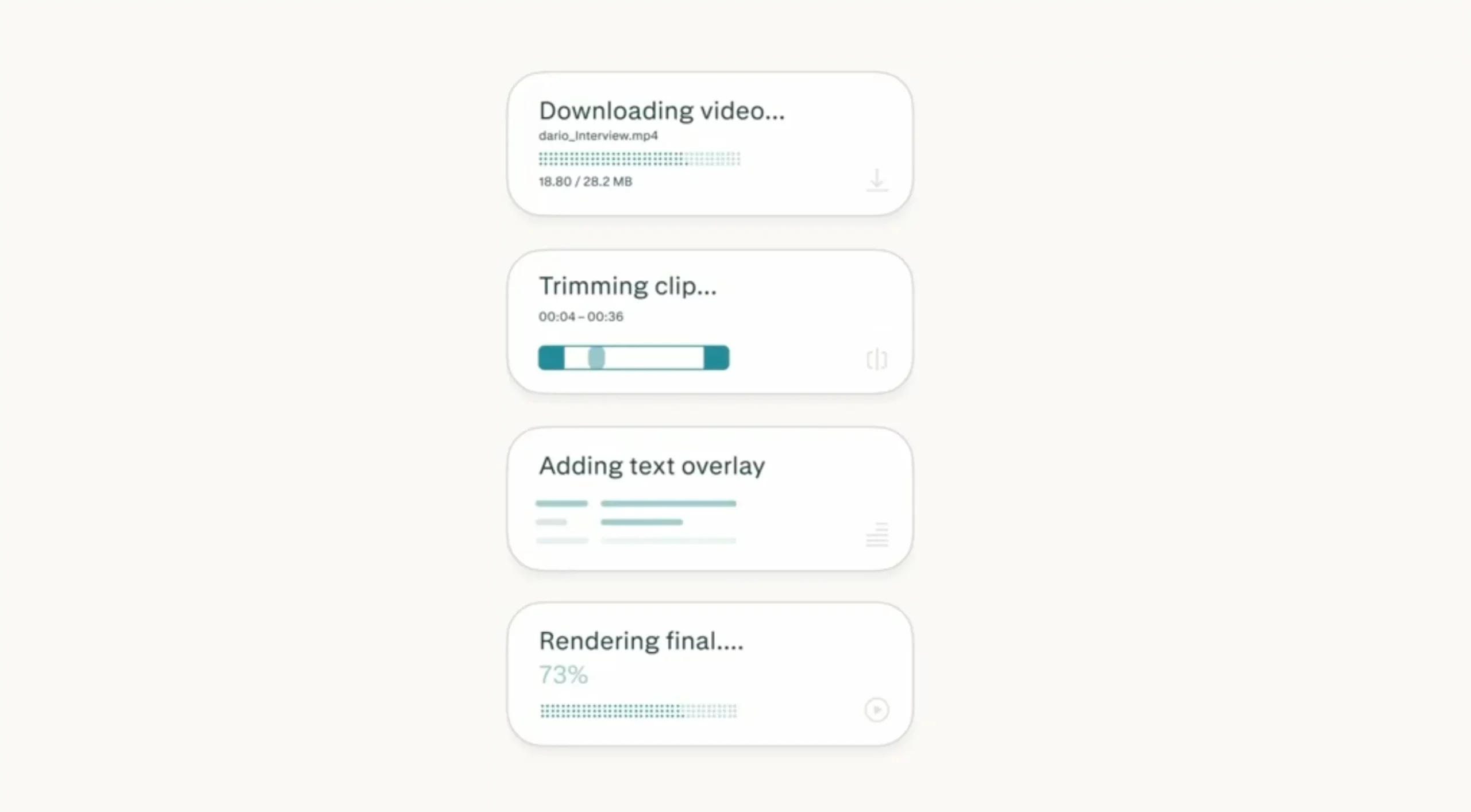
From there, the system would automatically:
understand the goal
download the podcast
locate the relevant segment
extract the clip
convert the video to vertical format
generate captions
render the final output
Instead of guiding you through the process, the AI executes the workflow itself.

Example: Preparing an AI Product Launch
Another example demonstrates how Perplexity Computer could handle a more complex project.
Imagine preparing to launch a new AI product.
Normally this would involve:
researching competitors
analyzing pricing benchmarks
writing positioning documents
building a landing page
creating visuals
drafting launch emails
preparing social media announcements
With Perplexity Computer, you could simply prompt:
“Prepare a complete launch kit for my AI productivity tool targeting remote teams.”
From there, multiple agents begin working simultaneously.
For example:
one agent researches competitors and market positioning
another gathers pricing benchmarks
another drafts the landing page copy
another generates visuals and demo screenshots
another prepares launch emails and LinkedIn announcements
If new information is needed, the system gathers it automatically. If a problem appears, additional agents are created to solve it.
Eventually, the system compiles everything into a complete launch package.
Why This Matters
For most of the AI boom, tools have focused on generating information.
They could answer questions, generate ideas, and help people think.
But they rarely executed work.
Perplexity Computer represents a shift toward something different.
Instead of AI that only advises, we are moving toward AI that operates.
Instead of telling you what to do, the system completes the workflow itself.
Interestingly, the word “computer” originally referred to people who performed complex calculations by dividing work among multiple individuals.
Perplexity’s idea follows a similar concept.
Instead of humans dividing the work, AI agents divide and complete it automatically.
And if systems like this continue to evolve, the next productivity upgrade may not be another piece of software.
It may be a digital coworker you assign tasks to.
Thats it
See you at the next one
Aniket