
AI Makes Thinking Optional
AI didn’t just automate work.

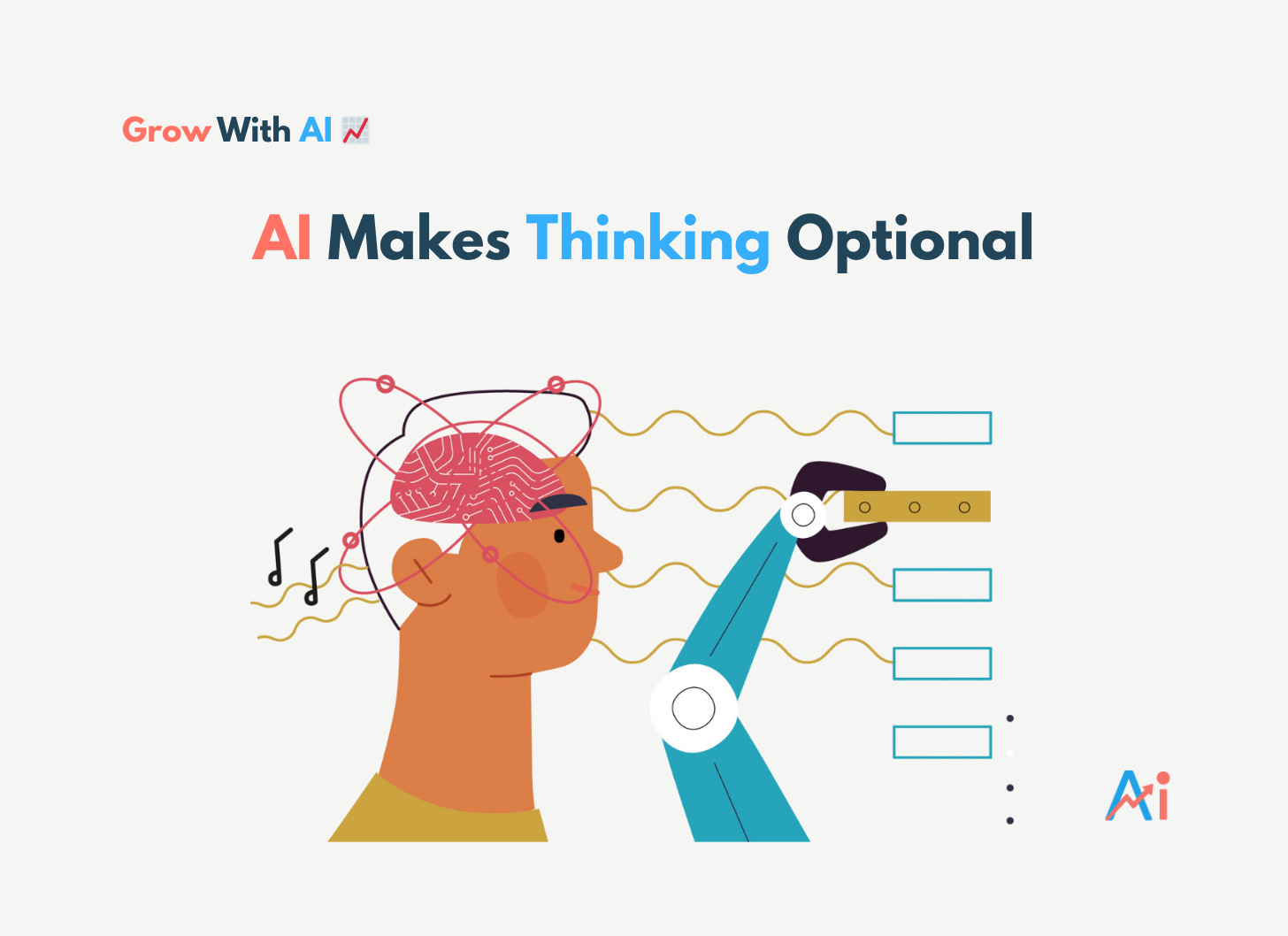
It quietly made thinking optional.
And most people didn’t notice because nothing broke immediately.
The Subtle Shift We’re Living Through
Before AI, thinking was unavoidable.
You had to:
Struggle through ambiguity
Sit with uncertainty
Reason your way forward
Decide without full information
Now?
You can outsource:
Drafting
Planning
Research
Summarizing
Even “what should I do next?”
The danger isn’t that AI thinks for us.
It’s that we stop thinking at all.
Delegation Used to Have a Cost
Delegating work used to require:
Trust
Communication
Accountability
Consequences
Delegating to AI feels frictionless.
No ego. No pushback. No social cost.
So people delegate earlier than they should.
They delegate:
Before forming an opinion
Before understanding the problem
Before developing intuition
That’s not leverage. That’s abdication.
What Actually Atrophies When You Over-Delegate
This isn’t abstract. It shows up in real work.
1. Judgment
If AI always gives you the first answer, you stop practicing deciding what’s right.
You start accepting what’s available.
2. Mental Endurance
Thinking is a muscle.
When every hard moment is offloaded:
Focus weakens
Patience drops
Depth disappears
You feel busy — but shallow.
3. Taste
Taste is built by exposure, comparison, and reflection.
If AI always generates options for you, you never develop the instinct to say:
“This feels wrong.”
And taste is one of the last things AI can’t fake convincingly.
4. Ownership
When outcomes fail, there’s a quiet shift:
“That’s what the AI suggested.”
No one says it out loud — but it changes how responsibility feels.
Why This Feels Productive (But Isn’t)
AI gives instant momentum.
You get:
Output
Motion
Progress indicators
But productivity isn’t movement.
It’s direction + intention.
AI is incredible at movement. It’s neutral about direction.
If you skip the thinking phase, you move faster just not necessarily anywhere meaningful.
The Real Risk Isn’t Dependence
People worry about “AI dependence.”
That’s not the real issue.
The real risk is premature delegation.
Using AI:
Before you understand the problem
Before you define constraints
Before you decide what matters
AI should accelerate thinking — not replace it.
A Healthier Mental Model
Use AI like this:
Think first. Then ask.
Decide direction. Then generate.
Form an opinion. Then refine.
Not:
“Tell me what to think.”
But:
“Challenge my thinking.”
The value isn’t the answer. It’s the friction AI introduces after you’ve engaged your own mind.
Why This Matters Long-Term
In the next few years:
Everyone will have access to powerful AI
Everyone will generate competent output
The differentiator won’t be who uses AI.
It will be:
Who still thinks deeply
Who can sit with complexity
Who knows when not to delegate
AI raises the floor.
But thinking still defines the ceiling.
Final Thought
AI makes thinking optional.
That feels like freedom.
But optional thinking creates optional clarity, optional responsibility, optional excellence.
The people who win won’t be the ones who delegate the most.
They’ll be the ones who know what not to delegate.
See you next week,
Aniket
You delegate the task to AI but if you don't think about the prompt and context and you don't know how ti filter and judge the output you will generate just AI slop. Using AI requires lot of thinking